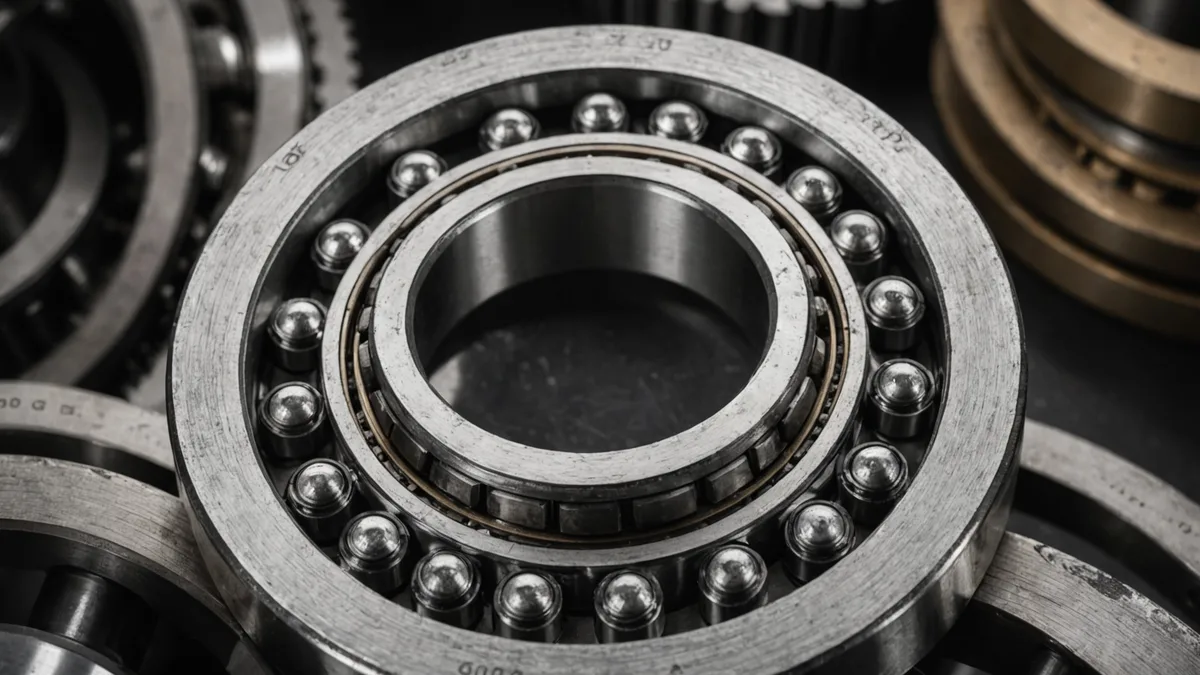
The first sign most plants get that a bearing is failing is a noise — a grinding, a squeal, a rhythmic knock. By that point, you're already in emergency territory. The physical damage is well underway. You're looking at an unplanned shutdown, an emergency parts order, and the ripple effects on every downstream process that was depending on that pump or compressor or motor.
The frustrating thing is that the bearing was trying to tell you something weeks earlier. It just wasn't speaking in a language anyone was listening to. That language is vibration frequency, and understanding it is the core of condition-based bearing monitoring.
What Bearing Defect Frequencies Actually Are
Every rolling element bearing has a geometry that produces predictable vibration signatures when individual components begin to degrade. These are calculated from the bearing's physical dimensions — number of rolling elements, contact angle, pitch diameter, and rotational speed — and they manifest as discrete peaks in the vibration frequency spectrum.
The four primary defect frequencies are:
- BPFO (Ball Pass Frequency, Outer Race) — The frequency at which rolling elements pass over a defect on the outer race. This is often the first defect to appear in radially loaded bearings because the outer race carries the highest load concentration.
- BPFI (Ball Pass Frequency, Inner Race) — Rolling elements passing over an inner race defect. Inner race defects are often load-zone modulated, meaning the peak amplitude cycles as the inner race rotates relative to the load direction.
- BSF (Ball Spin Frequency) — Frequency produced by a defect on a rolling element itself. BSF-related faults are often accompanied by sidebands at cage frequency (FTF).
- FTF (Fundamental Train Frequency) — The cage rotation frequency. Elevated FTF and its harmonics suggest cage damage or inadequate lubrication allowing cage-element slip.
These frequencies are deterministic. Given a bearing's part number and the shaft RPM, you can calculate exactly where to look in the spectrum. That's what makes vibration-based bearing monitoring tractable — it's not pattern recognition from first principles, it's knowing where the signal should appear and watching that specific bin.
The Progression: From Clean Spectrum to Failure
Bearing degradation doesn't happen overnight, and the frequency spectrum tells you where you are in that progression. The ISO 13373 standard describes a four-stage model that maps well to what we see in continuous vibration data from centrifugal pumps and motors.
Stage 1: Ultra-high frequency stress waves (typically above 20 kHz in the high-frequency envelope) begin appearing as microscopic surface fatigue develops. At this stage, overall vibration RMS hasn't changed at all. You won't see anything unusual if you're only looking at broadband velocity. This stage can last weeks to months depending on load, speed, and lubrication quality.
Stage 2: Bearing defect frequencies (BPFO, BPFI) become visible in the spectrum, initially without sidebands. The absolute amplitudes are still low — often less than 0.1 in/s — but the frequencies are in the right place. This is the earliest practically useful warning signal. At this point, the bearing is functionally usable but degrading. On a 1750 RPM pump with a typical SKF 6308 deep groove ball bearing, BPFO would appear around 59 Hz. Seeing an emerging peak there, even small, is meaningful.
Stage 3: Sideband families appear around the defect frequencies, spaced at the shaft turning speed (1X). This indicates the defect has propagated enough to cause periodic modulation. Overall vibration begins rising measurably. Temperature at the bearing housing often starts increasing. This is the zone where you have a firm maintenance window — typically 2-4 weeks before functional failure, depending on the asset's load cycle.
Stage 4: Noise floor rises across a wide frequency band (a phenomenon called "white noise rise"), 1X and 2X amplitudes increase due to mass imbalance from bearing material loss, and broadband vibration spikes. You're days to weeks from catastrophic failure at this point. If you're catching it here, you're behind.
Why Audible Noise Is a Stage 3-4 Indicator
Human hearing responds to vibration in the 20 Hz to 20 kHz range, with best sensitivity between 1-4 kHz. The stress waves that appear in Stage 1 bearing degradation sit well above this — typically 20-80 kHz. The structural resonances excited in Stage 2, where defect frequencies first appear, are still often below audible threshold in an industrial environment.
The mechanical noise you can hear — the grinding, the squeal — is the sound of metal-to-metal contact, of material being shed from the race or rolling element. That's Stage 3 at the earliest, often Stage 4. A technician doing a weekly walkaround who hears something abnormal and reports it is almost certainly reporting a bearing that's already past the ideal intervention window.
We're not saying walkarounds are useless. Experienced technicians catch things that sensors miss — unusual smells, visual fluid leaks, vibration felt through the floor. But for bearing health specifically, by-ear detection is a lagging indicator, not an early warning system.
A Scenario: 1750 RPM Process Pump, 40 HP
Consider a horizontal centrifugal process pump, 1750 RPM, 40 HP motor, running on a cooling water circuit at a plastics compounding facility. The pump has been running reliably for 14 months. No recent maintenance. Time-based PM schedule calls for bearing inspection at 18 months.
A triaxial accelerometer mounted on the drive-end bearing housing begins streaming data. At week 1, the vibration spectrum is clean — 1X and 2X peaks at normal amplitudes, no bearing defect frequencies visible above the noise floor. Baseline is established.
At week 7, BPFO appears faintly at 61.3 Hz (calculated from shaft speed and bearing geometry). The amplitude is 0.04 in/s — below most alert thresholds. Overall velocity RMS hasn't changed. The bearing sounds fine. Temperature is normal.
At week 11, the BPFO peak is now 0.11 in/s and has acquired sidebands spaced 29.2 Hz apart (1X). This is Stage 3. Overall velocity has risen from a baseline of 0.08 in/s to 0.19 in/s. The asset health score has dropped from 91 to 62.
The PM call is made. A technician replaces the drive-end bearing on a scheduled weekday day shift. Cost: 2.5 hours labor, one bearing, no production loss. If the bearing had run to failure, the estimate is 14-18 hours unplanned downtime, possible shaft damage, possible impeller damage from shaft deflection, and emergency parts at premium freight cost.
The difference between those two outcomes was the ability to read Stage 2 and early Stage 3 data.
Axis Selection Matters
Not all measurement axes provide equal information for bearing fault detection. For horizontal centrifugal pumps, the radial axes (horizontal-radial and vertical-radial) typically show BPFO and BPFI most clearly because the load zone is radial. The axial axis is more sensitive to thrust bearing faults and misalignment.
For overhung impeller pumps specifically, the radial vibration at the drive-end bearing is often elevated by the overhung load, which can mask early bearing defect frequencies in that direction. In these configurations, Fleetpio's baseline calibration accounts for this structural characteristic by learning what "normal" radial amplitude looks like for that specific pump, rather than using a generic absolute threshold.
The non-drive-end bearing is often the one that fails first in these configurations, paradoxically, because it carries thrust load from the impeller and is more susceptible to axial overloading when the pump operates off-BEP (best efficiency point). Mounting sensors on both bearing housings — not just the drive-end — doubles the information and catches this failure mode.
Integration: From Spectrum to Work Order
The gap in most condition monitoring programs isn't the physics — it's what happens after you detect something. Vibration data sitting in a condition monitoring software package does nothing if a technician doesn't see it, triage it, and get it into the CMMS as a work order with the right priority and the right parts ordered.
The way Fleetpio handles this is by translating the spectral evidence directly into a health score and a maintenance recommendation, then pushing that recommendation into the CMMS automatically when the score crosses a configured threshold. The technician doesn't receive a frequency plot and a number — they receive a work order that says "drive-end bearing replacement recommended, outer race defect frequency elevated, estimated 2-3 week window" with the sensor data attached for reference.
That translation step — from BPFO amplitude to actionable work order — is where most manual condition monitoring programs leak value. The analysis might be correct, but if the recommendation takes 3 days to reach the planner's inbox via email, and another 2 days to become a scheduled work order, you've lost a third of your available P-F window.
Continuous monitoring with automated triage closes that gap. The signal is there in the data weeks before you'd catch it by ear. The question is whether your monitoring system is reading it, and whether your maintenance workflow is set up to act on it fast enough to matter.