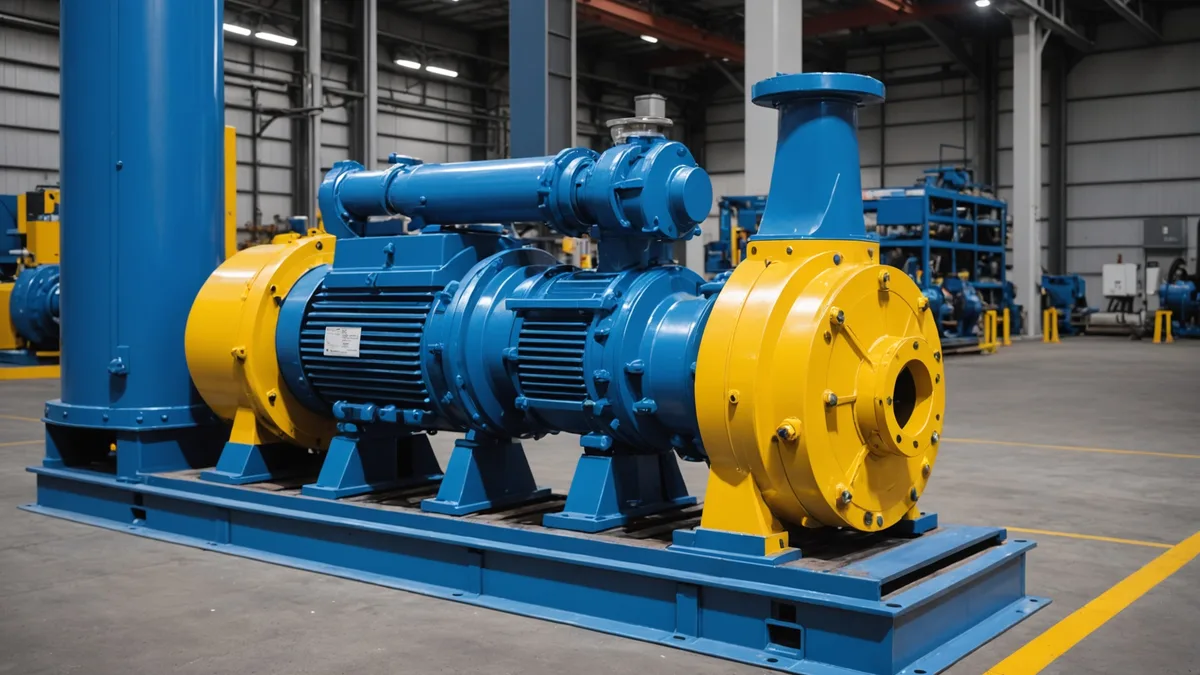
Sensor placement is the first physical decision in any vibration-based condition monitoring deployment, and it's the one that most determines what you can and can't detect. Getting it right requires understanding not just the general principle — "mount close to the bearing" — but the specific fault modes you're targeting, the mechanical structure of the pump, and the tradeoffs between comprehensive coverage and practical installation constraints.
This guide covers horizontal end-suction centrifugal pumps, which is the most common configuration in process industries. The principles apply broadly to other centrifugal configurations (vertical in-line, split-case, multistage), but those have additional considerations addressed at the end.
The Basic Framework: Measurement Locations and Axes
A standard horizontal centrifugal pump — motor, coupling, pump casing — has four primary measurement locations:
- Motor drive-end (DE) bearing housing — closest to the coupling, highest transmitted dynamic load from the coupling
- Motor non-drive-end (NDE) bearing housing — fan end of the motor, lower transmitted load from coupling, but often carries cooling fan imbalance contributions
- Pump drive-end bearing housing — closest to the coupling on the pump side, carries radial and some axial load
- Pump non-drive-end bearing housing — near the impeller/seal end, carries the hydraulic thrust load from the impeller
At each location, a triaxial accelerometer measures three orthogonal directions:
- Horizontal-radial (H) — perpendicular to shaft axis, horizontal plane. Primary direction for detecting radial imbalance, bearing defects in radially loaded bearings.
- Vertical-radial (V) — perpendicular to shaft axis, vertical plane. Structural resonances often show different signatures in V vs H due to different vertical vs horizontal stiffness of the machine train.
- Axial (A) — parallel to shaft axis. Primary direction for detecting misalignment, thrust bearing faults, and axial vibration modes.
Minimum Viable Deployment vs Comprehensive Coverage
If you're instrumenting a large fleet and can only put one sensor per pump, the highest-value placement is the pump NDE bearing housing, measuring at minimum the radial axes. Here's the reasoning:
The pump NDE bearing is typically the weakest point in a centrifugal pump's bearing arrangement. It carries the hydraulic thrust force from the impeller, which is always present and load-direction-fixed (toward the suction side). This bearing sees combined radial and axial loading, and its failure consequences are often severe because it's adjacent to the mechanical seal — when the pump NDE bearing fails and allows shaft deflection, it frequently damages the mechanical seal simultaneously. A single failure event becomes two components requiring replacement.
Placing a triaxial sensor at the pump NDE location gives you: bearing defect frequency detection (BPFO, BPFI) for the bearing most likely to fail first, axial vibration for detecting thrust imbalance and misalignment effects that transmit well to this location, and proximity to the mechanical seal's vibration environment (seal face vibration often shows up in the NDE radial spectrum as broadband noise increase).
That said, a single sensor deployment misses the motor bearings entirely, and motor bearing failures are the second most common failure mode in motor-pump trains. Two sensors — one at pump NDE and one at motor DE — provide substantially better coverage. Motor DE is prioritized over motor NDE because coupling misalignment transmits strongly to both the pump DE and motor DE bearings and shows clearly in the axial axis at this location.
Why the Mounting Surface Matters as Much as the Location
The best sensor placement on the right bearing housing can still produce poor data if the mounting method is wrong. The accelerometer needs a rigid, flat, clean mechanical connection to the bearing housing to accurately transmit high-frequency vibration. For wireless sensor nodes that use magnetic mounting — a practical solution for rapid deployment without hot-work permits — the key considerations are:
Surface flatness: Curved bearing housings require a curved mounting adapter or a sufficiently small magnet footprint to avoid rocking. A magnet that spans a curved surface will couple poorly and attenuate the high-frequency components most useful for Stage 1/2 bearing fault detection.
Surface cleanliness: Oil, paint overspray, or corrosion between the magnet and the housing introduces an air gap that dramatically reduces high-frequency transmission. Even a thin layer of paint can reduce the upper frequency limit of useful data. Where possible, mount to bare metal or use a thin metal adapter pad bonded to the surface.
Structural path: The sensor must be coupled to the bearing housing, not to a guard or cover plate that's isolated from the bearing housing by a gasket or vibration mount. This sounds obvious but it's a common installation error — covers and guards on motors and pump casings can look like good mounting surfaces while being mechanically isolated from the structure you're actually trying to monitor.
Resonance avoidance: Thin sheet metal surfaces (junction box covers, fan cowls) have their own structural resonances that can swamp bearing fault frequencies. If the only accessible surface in the right location is thin sheet metal, use a stud-mounted adapter pad or a different location.
Fault Mode — Sensor Location Mapping
Different fault modes transmit differently through the pump structure, which means sensor placement optimized for one fault mode may be suboptimal for another.
Bearing defect frequencies (BPFO, BPFI, BSF): Best detected at the bearing housing of the affected bearing, in the radial axes. High-frequency stress waves (for Stage 1 detection) attenuate quickly through structural paths, so the sensor needs to be on or very close to the bearing housing. A sensor 200mm away from the bearing housing, connected through multiple structural joints, may not see Stage 1 signals at all.
Mass imbalance (rotor imbalance): Shows as elevated 1X (once per revolution) in the radial axes. Transmits well through the shaft and bearing structure, so it's detectable at any radial location on the machine train. Both motor and pump radial sensors will show imbalance, though the amplitudes will differ based on bearing stiffness and rotor mass.
Misalignment: Shows as elevated 2X and sometimes 1X, with strong axial components. The axial axis at motor DE and pump DE bearing housings is the primary measurement location. Coupling misalignment (angular) shows more strongly in axial at DE locations than radial. Parallel offset misalignment tends to show more in radial.
Cavitation: Impeller cavitation produces broadband high-frequency noise (often 1-10 kHz range) and sub-synchronous random bursts. The pump NDE bearing housing radial axes show cavitation most clearly because of their proximity to the impeller. The motor sensors are too far from the impeller to reliably detect mild cavitation — it's detectable at the pump sensors first.
Looseness: Mechanical looseness (rotor-to-stator, bearing outer race in housing, foundation) produces sub-harmonic (0.5X) and higher harmonics of running speed. Detectable at radial locations across the machine train, with different amplitudes at different positions depending on where the looseness is located.
Special Considerations: Overhung Impeller Pumps
We're not saying the standard two-bearing measurement approach is wrong for overhung pump configurations — it's the right starting point. But overhung impeller designs (where the impeller extends beyond the outboard bearing, cantilevered on the shaft) have a specific complication: the overhung mass creates a dynamic moment that loads the outboard bearing with higher radial force than a centered impeller design.
In overhung pumps, the NDE bearing (outboard, closest to the impeller) carries the highest radial load. The vibration amplitudes at this bearing are typically higher than for equivalent in-line configurations, which means the baseline at this location will be naturally elevated. When establishing baselines for overhung pump sensors, the normal-operating radial amplitude will look high by generic ISO 10816 standards and shouldn't be interpreted as a fault. What matters is the trend from that specific pump's baseline, not comparison to generic thresholds.
Vertical Pumps and Multi-Stage Configurations
Vertical in-line pumps (common in building HVAC and process water systems) have a different mechanical structure: the motor is above the pump, connected by a vertical shaft. Measurement locations shift: the top motor bearing housing is the primary bearing monitoring location, and the lower bearing housing (or upper pump bearing) handles the combined radial and thrust load from the impeller below.
For vertical turbine pumps (long shaft, impeller submerged), surface measurements at the motor are far from the critical bearings in the column. In these configurations, the column bearings are often the first to fail and are physically inaccessible for direct monitoring. What you can do: monitor at the accessible motor and discharge head bearings, and use the data as an indicator of system-level changes. A degrading column bearing will often change the vibration signature at the motor, though the signal is attenuated through the long shaft.
For multi-stage pumps (stacked impellers on a single shaft), the mechanical complexity increases the number of potential fault sources. Stage 2 and stage 4 impeller conditions can produce blade pass frequency harmonics at different levels. The sensor placement follows the same logic — closest to the most-loaded bearing — but interpreting the spectra requires understanding which impeller stage and interstage bushing is contributing to which frequency component.
The Deployment Checklist
Before commissioning a new sensor on a centrifugal pump, run through this physical verification:
- Sensor is mounted on the bearing housing, not on a cover or structural member isolated from the bearing housing
- Mounting surface is flat, bare metal, and clean — no rust scale, paint buildup, or oil film between magnet and surface
- Sensor orientation is recorded: which axis of the triaxial sensor corresponds to radial horizontal, radial vertical, and axial
- The cable or wireless path is clear of moving parts (shaft, coupling, belt) and isn't creating a transmission path for external vibration
- A baseline data collection period of at least 7 days (14 days preferred) covers the full range of normal operating load conditions before any alert thresholds are activated
The deployment decisions made at installation determine the quality of data you'll be interpreting for the life of the monitoring program. Time spent on correct sensor placement and careful baseline establishment pays back every time a fault appears in the data clearly enough to act on with confidence.