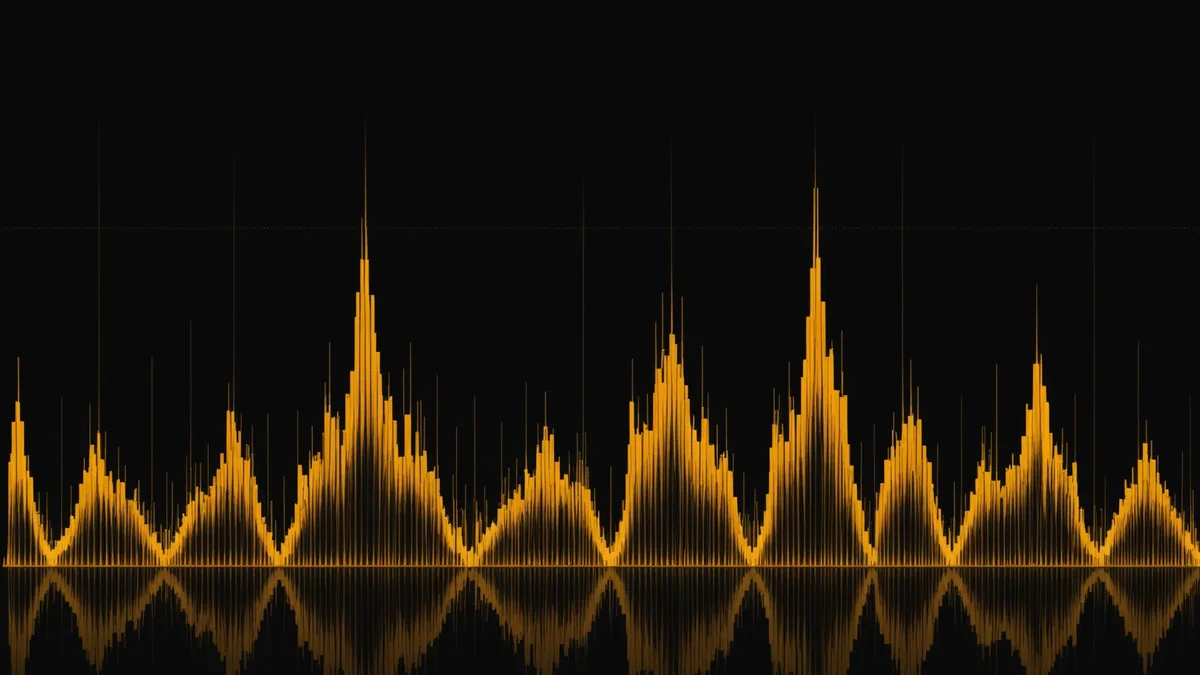
A vibration spectrum is a frequency-domain representation of how much energy a machine is producing at each frequency. To a trained reliability engineer, it reads like a machine's self-report: each component produces energy at predictable frequencies, and when those frequencies change in amplitude — or when new ones appear — the spectrum tells you which part is degrading and roughly how far along the degradation has progressed.
We've worked through a lot of rotating equipment spectra building Fleetpio's health scoring engine, and the five patterns described here are the ones that appear most consistently across the equipment classes we monitor: pumps, compressors, motors, and fans. This isn't an exhaustive fault library — that runs to hundreds of pages in any good vibration analysis text — but these five are the ones that catch the majority of failures before they become unplanned events.
Pattern 1: Elevated 1X Synchronous — Imbalance and Shaft Issues
The 1X frequency is running speed expressed in Hz. For a 1,800 RPM motor, that's 30 Hz; for a 3,600 RPM compressor, it's 60 Hz. Every rotating machine produces some energy at 1X — a perfectly balanced machine still has some residual imbalance. The question is how much, and whether it's changing.
Elevated 1X in the radial direction (horizontal or vertical) is the primary indicator of mass imbalance. The diagnosis is directional: a single dominant 1X with clean harmonics that drop off quickly suggests classical imbalance. If 1X and 2X are both elevated in the radial plane, shaft bow or bent shaft becomes a candidate. If 1X is elevated predominantly in the axial direction, structural looseness or a resonance issue is worth investigating before calling it imbalance.
Which axes to watch: both radial directions (horizontal and vertical) at the bearing housing. Axial axis for context. For single-stage pumps and fans, imbalance is often the most common fault mode, so 1X trend monitoring is the first column in any baseline review.
Pattern 2: Sub-Synchronous Energy — Fluid Instability and Looseness
Sub-synchronous vibration is energy appearing below 1X in the spectrum — frequencies that are a fraction of running speed. It's the pattern that trips up technicians who are primarily watching harmonics of running speed, because it doesn't fit the 1X/2X/3X framework.
The two main causes are fluid film bearing instability (oil whirl / oil whip in journal bearings) and mechanical looseness. Oil whirl appears at approximately 0.43–0.48X of running speed — if a machine runs at 60 Hz, oil whirl shows up near 26–29 Hz. Oil whip locks onto a structural resonance frequency and stays there even as speed changes, which is how you distinguish it from whirl. Both are serious: journal bearing instability can progress quickly once initiated.
Mechanical looseness produces a different sub-synchronous signature: fractional harmonics at 0.5X, 1.5X, 2.5X, and so on. These appear alongside elevated harmonics of 1X and often show up more prominently in the axial direction. Looseness on a pump baseplate, for example, might show this pattern and be dismissed as imbalance, but the fractional harmonics are the tell.
We're not saying sub-synchronous energy is always a crisis — some small amount of 0.5X is fairly common on machines with sleeve bearings. The threshold question is whether it's growing over time and whether it's appearing in combination with other fault indicators.
Pattern 3: Bearing Defect Frequencies (BPFO / BPFI / BSF / FTF)
Rolling element bearing defect frequencies are calculated from bearing geometry and running speed. The four standard frequencies are:
- BPFO (Ball Pass Frequency, Outer race): the frequency at which rolling elements pass a defect on the outer race. Depends on number of balls, contact angle, and speed.
- BPFI (Ball Pass Frequency, Inner race): same concept for the inner race. BPFI is typically higher than BPFO for the same bearing.
- BSF (Ball Spin Frequency): the frequency at which a rolling element spins on its own axis.
- FTF (Fundamental Train Frequency): the cage rotation frequency, typically 0.35–0.48X of shaft speed.
In practice, BPFO is the most commonly observed early-stage defect signature in heavily loaded applications — the outer race is stationary and under continuous load, so defects develop there first under normal conditions. The early BPFO signature appears as a small peak at the calculated frequency, often with sidebands at 1X shaft speed on either side. As the defect grows, sideband count increases and the peak amplitude rises. Late-stage bearing failure shows broadband high-frequency energy (the stress wave pattern covered below) on top of the defect frequency peaks.
The key diagnostic discipline here is calculating the bearing-specific frequencies for each machine. Generic frequency bands don't capture BPFO accurately — you need the bearing number, shaft speed, and load zone to set a useful monitoring threshold. This is one of the places where Fleetpio's per-asset baselining matters: we calculate defect frequencies specific to each bearing type at each shaft speed rather than applying population-wide frequency bands.
Pattern 4: Gear Mesh Frequency (GMF) and Sidebands
Gearboxes produce energy at gear mesh frequency, calculated as the number of teeth on a gear multiplied by its rotational speed in Hz. A 30-tooth gear on a 1,800 RPM shaft produces GMF at 900 Hz. The diagnostic value is in the sidebands around GMF: sidebands spaced at the rotational frequency of the input shaft indicate wear on the input gear; sidebands at the output shaft frequency indicate wear on the output gear.
Healthy gearboxes produce a clean GMF peak with minimal sidebands. As gear tooth wear progresses, sideband amplitude increases relative to the GMF peak. In more advanced wear, you see multiple sideband orders and a rise in the noise floor around GMF.
For cooling tower fans and turbine-driven equipment where a gearbox is in the drive train, GMF monitoring adds meaningful early warning beyond what bearing analysis captures alone. The challenge is frequency range: GMF for industrial gearboxes often falls between 200 Hz and 2,000 Hz, requiring sensor bandwidth and sampling rates above what's sufficient for standard bearing analysis. Confirm your sensor specs cover the relevant GMF range before concluding that your gearbox is healthy based on a flat spectrum.
Pattern 5: High-Frequency Stress Wave Energy — Late-Stage Bearing and Surface Damage
The fifth pattern is distinct from the others because it appears at high frequencies — typically 5 kHz to 20 kHz — and indicates microscopic surface damage rather than the periodic load variations that produce the lower-frequency fault signatures. Techniques that capture this energy include high-frequency envelope analysis, Spike Energy (a trademarked term from IRD Mechanalysis, but used generically for this signal type), and stress wave analysis.
High-frequency energy rises when rolling element surfaces or gear teeth develop micro-pitting, spalling, or subsurface cracks. The signal is usually non-periodic in raw form but shows characteristic envelope patterns when demodulated. It appears before the defect is large enough to produce a strong BPFO or BPFI peak in the standard frequency range, which is why it's used as an early fault indicator — particularly in low-speed bearings where defect frequencies fall below 5 Hz and are difficult to distinguish from background noise.
The practical implication: if you see rising high-frequency energy on an asset without a corresponding BPFO or BPFI peak, you're likely in early-stage surface damage. That's a watchlist situation, not yet a work order — but it means increasing monitoring frequency and setting a tighter threshold on trend rate of change. If BPFO also appears within the next few weeks, the picture is clear and you schedule replacement.
Using These Patterns Together
Real fault diagnosis is rarely one pattern in isolation. A degrading pump drive-end bearing will often show: rising BPFO with 1X sidebands (bearing defect), a slight rise in 1X radial (secondary imbalance as the rotor begins to run off-center), and eventually high-frequency stress wave energy as the rolling elements begin to spall. Watching the pattern combination — and tracking which appeared first and how they're trending relative to each other — is more diagnostic than looking at any single frequency band.
That's the logic behind health scoring rather than individual alert thresholds. A single bearing frequency peak at twice its baseline is ambiguous. The same peak, combined with rising high-frequency energy and a 15% increase in bearing housing temperature over the past three weeks, is a clear statement about asset condition. The combination and trend are what produce a reliable prediction horizon rather than a false alarm rate that trains technicians to ignore alerts.
Building a spectrum literacy within your reliability team — knowing which patterns indicate which faults, and which axes carry the relevant signal for each equipment type — is what separates condition monitoring that drives maintenance decisions from vibration data that sits in a dashboard and gets reviewed when something breaks anyway.