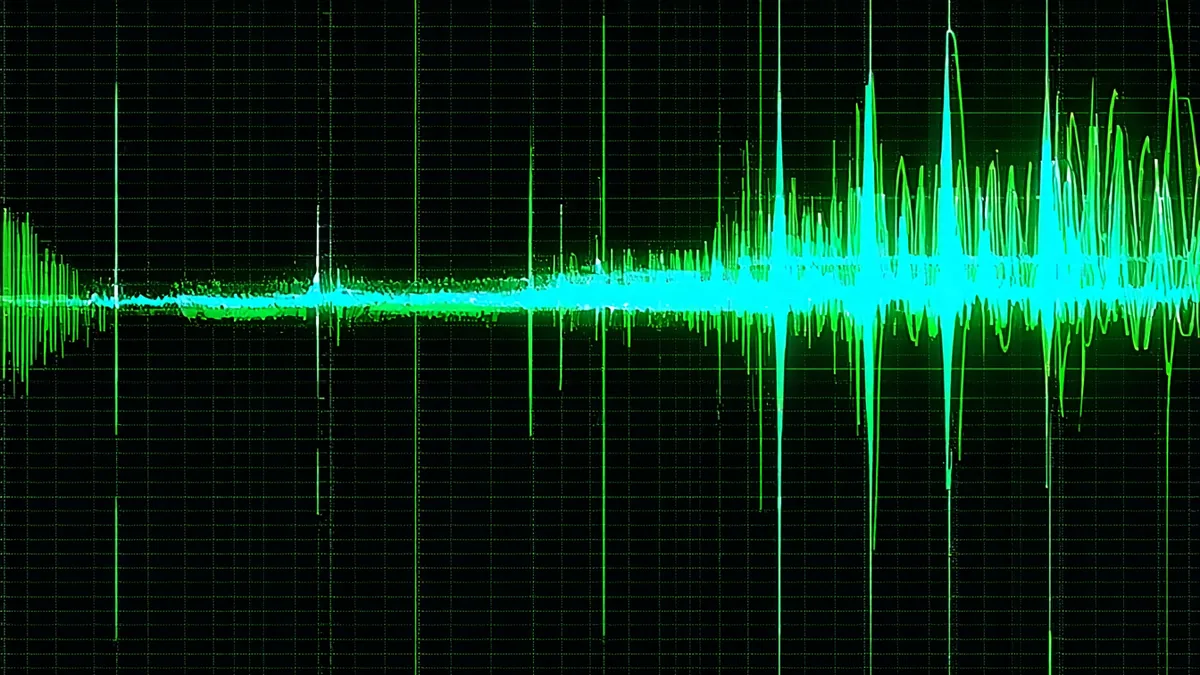
Most commercial refrigeration compressors don't fail suddenly. They degrade — usually over four to eight weeks — and the vibration signature during that degradation window is distinctly different from healthy operation. The problem is that most fleet operators never read that signature until the unit is already down and the cold chain is broken.
Calendar-based maintenance schedules are designed around average failure intervals, not actual equipment condition. A compressor replaced on a 12-month PM schedule might get swapped out at nine months of useful life remaining — or kept in service two months past the point where vibration data showed clear bearing wear. Neither outcome is efficient. The first wastes parts and labor; the second spoils inventory.
The Frequency Bands That Matter
Vibration analysis in commercial refrigeration compressors focuses on a narrower set of frequency bands than you'd monitor in, say, a large industrial centrifugal pump. For scroll and reciprocating compressors — the two types most common in commercial food logistics — the useful diagnostic range sits between 10 Hz and roughly 2,000 Hz. Within that range, four sub-bands carry most of the predictive signal:
- 10–50 Hz (low-frequency): Imbalance and misalignment. A rising baseline in this band, especially with a 1× running-speed harmonic, is an early indicator that the crankshaft or scroll assembly is no longer running true. In scroll compressors, this often precedes scroll tip wear by three to five weeks.
- 50–500 Hz (mid-frequency): Bearing outer and inner race defect frequencies. The BPFO (ball pass frequency outer race) and BPFI (ball pass frequency inner race) calculations depend on bearing geometry, but for typical refrigeration compressor bearings, defect frequencies land in the 80–350 Hz range. A sideband pattern around these frequencies is the earliest reliable indicator of bearing degradation — often detectable at six to eight weeks before audible noise or thermal elevation.
- 500–1,000 Hz: Early-stage scroll wear in scroll compressors. As the scroll tip clearance opens, the gas-leakage path introduces a specific broadband noise floor elevation in this range. It's subtle — often 2–4 dB above baseline — but consistent across the degradation curve.
- 1,000–2,000 Hz: Advanced mechanical distress. By the time you're seeing significant energy here, you're dealing with something that needs immediate attention. Reciprocating compressors with valve failure present heavily in this range during compression and expansion strokes.
What a Degradation Curve Actually Looks Like
Consider a walk-in cooler compressor at a wholesale produce facility running a scroll unit at approximately 3,450 RPM. Under healthy operation, vibration in the 10–500 Hz band sits at a relatively flat baseline with expected 1× and 2× running-speed harmonics. Nothing unusual.
At T-minus 6 weeks before failure, the first detectable change appears: a small but statistically consistent elevation in the 80–120 Hz band. In isolation, it looks like noise. But if you're tracking a rolling 7-day average against a unit-specific baseline, it's a 12–15% elevation that breaks the normal variance pattern.
At T-minus 4 weeks, that elevation has expanded into a broader band (60–180 Hz) and a 1× sideband appears around the bearing defect frequency. A technician doing a physical inspection at this point would probably hear nothing — the unit runs quietly, temperatures are in range, suction and discharge pressures look normal. Calendar maintenance would pass it.
At T-minus 2 weeks, the picture changes clearly. The sideband pattern is unmistakable in the FFT output, broadband energy in the 500–1,000 Hz range has risen 6–8 dB above baseline, and suction pressure has started drifting — first sign of reduced volumetric efficiency as the scroll wear begins affecting compression ratio.
At T-minus 1 week, the unit is running 4–6°F warmer than spec at the discharge line, the refrigerant pressure trend shows clear degradation in heat rejection capacity, and vibration energy above 1,000 Hz is elevated. This is when operators on calendar maintenance first notice something is wrong — by which point the repair window to avoid emergency dispatch has largely closed.
Why Amplitude Alone Is Insufficient
A common mistake in vibration-based condition monitoring is setting a single amplitude threshold and triggering alerts when any reading crosses it. That approach generates both false positives — thermal expansion on startup, load changes, brief resonance during compressor cycling — and false negatives when degradation progresses gradually within a wider variance envelope.
What actually works is pattern-based comparison against a unit-specific baseline, with statistical process control logic applied to the trend, not just point-in-time readings. ISO 10816-3 provides general vibration severity criteria for rotating machinery, but refrigeration compressors operate in a narrower duty cycle and at lower vibration levels than the industrial equipment those thresholds were calibrated for. Applying ISO 10816-3 limits directly to a 3-ton scroll compressor will result in missed detections — the thresholds are simply too coarse.
We're not saying amplitude thresholds are useless — they're a necessary safety net for catching sudden mechanical events. The point is that amplitude alone, without trend analysis against a unit-specific baseline, misses the gradual degradation patterns that represent the majority of compressor failures in commercial refrigeration.
The Calendar Maintenance Blind Spot
A 90-day PM schedule on a compressor that fails on a 60-day degradation curve will always be late. A 90-day PM schedule on a compressor that would have run fine for 18 months is throwing away parts and labor. The core problem with calendar-based maintenance isn't that it's wrong in principle — regular inspections have value — it's that it's calibrated to an average that doesn't describe any individual unit.
A fleet of 60 refrigeration units operated by a mid-size Colorado food distributor will have compressors with meaningfully different wear rates depending on duty cycle, refrigerant charge history, installation quality, ambient temperature conditions, and whether previous service intervals were done correctly. Running all 60 on the same 90-day schedule is a statistical average applied to 60 different machines.
What the Data Pipeline Needs to Look Like
To act on vibration signatures before they become failures, the data path needs a few specific characteristics:
- Per-unit baselines: Alerts calibrated against fleet averages miss unit-specific anomalies. Each compressor should have its own baseline established during a known-healthy operating period.
- Trend persistence, not point alerts: A single reading above baseline is noise. A 5-day trend of elevating readings in a specific frequency band is a signal. Alert logic needs a persistence window.
- Context at alert time: When a vibration anomaly triggers a work order, the technician receiving it should see the specific frequency band, the trend duration, the unit's service history, and the likely failure mode — not just "compressor anomaly detected." Generic alerts get ignored.
- Refrigerant pressure correlation: Vibration signatures alone don't distinguish between a bearing failure and a refrigerant-side problem. Cross-correlating vibration trends with suction/discharge pressure ratios and subcooling data narrows the failure mode significantly and improves parts pre-staging accuracy.
From Signal to Scheduled Visit
The operational goal isn't to generate a vibration report — it's to convert a degradation trend into a scheduled technician visit before the unit fails. That conversion requires two things: a reliable alert that reaches a dispatcher with enough lead time to book a non-emergency slot, and a work order with enough context that the technician brings the right parts.
In practice, the window between first detectable vibration anomaly and unit failure is typically three to six weeks for bearing wear in scroll compressors, and two to four weeks for scroll tip degradation. That window is large enough to schedule a planned visit during off-peak hours, pre-stage the correct bearing kit or scroll assembly, and avoid both the emergency rate multiplier and the cold chain disruption.
The signal exists in the data. The question is whether your maintenance workflow is structured to act on it before the failure event closes the window.