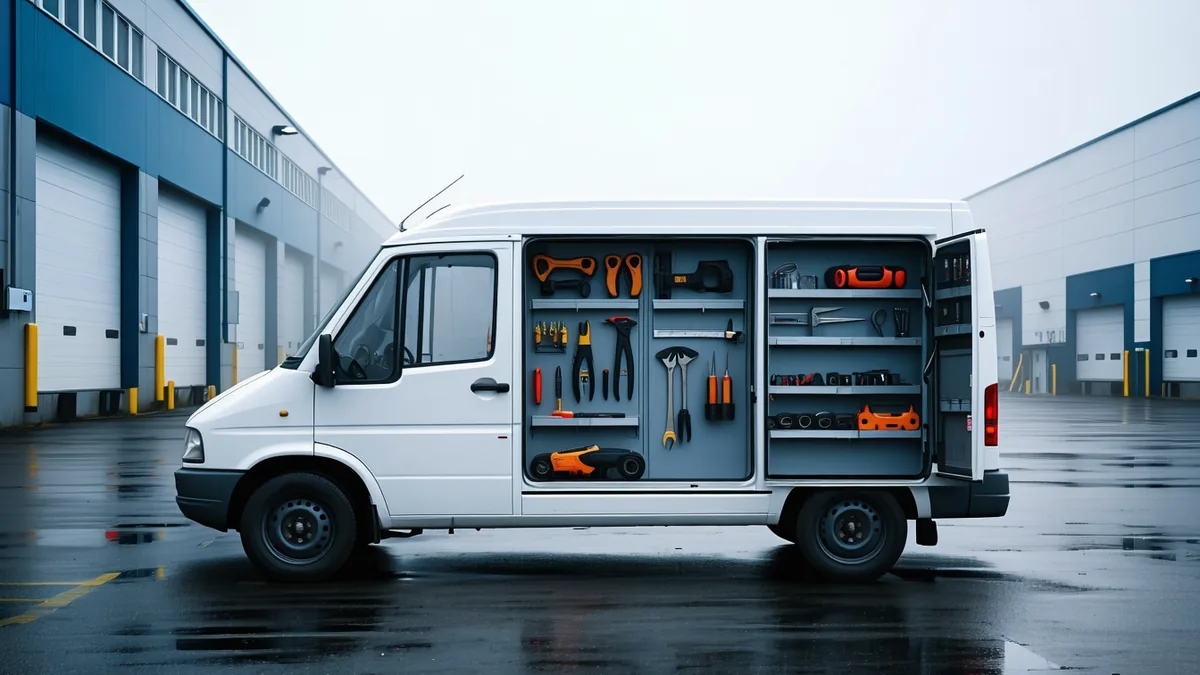
Dispatch efficiency in commercial refrigeration service is often measured by a single metric: response time. How fast did a technician get on-site after the call came in? That's a reasonable metric for emergency response capability, but it's a poor proxy for overall field service efficiency. A technician who arrives on-site in 90 minutes but needs to return twice because they didn't have the right parts, and whose emergency rate runs 2.5x the standard labor rate, is not an efficient service operation — regardless of the response time.
The efficiency problem in reactive refrigeration dispatch isn't speed. It's the compounding cost of everything that happens upstream of the service call: the part of the workflow that predictive scheduling can change and reactive dispatch structurally cannot.
The Hidden Costs of Reactive Ticket Dispatch
When a refrigeration unit fails and a ticket is created, several things happen in sequence that each carry a cost that rarely appears in a maintenance report:
After-hours premium. Commercial refrigeration failures don't respect business hours. A significant share of emergency calls happen during evenings, weekends, or holidays — when the failure is discovered by someone checking the facility, or when a temperature alarm finally triggers. After-hours service rates in the refrigeration sector typically run 1.8x–2.5x standard weekday rates for labor. On a repair that would cost $650 during business hours, the same job on a Saturday night costs $1,170–$1,625.
Parts unavailability. Emergency dispatches frequently occur without knowing the specific failure mode until the technician arrives and diagnoses. Unless the technician carries a comprehensive inventory of common refrigeration parts — compressors, capacitors, contactors, metering devices, bearing kits — there's a non-trivial probability of a first-trip diagnosis without a fix. A second truck roll adds travel time, labor hours, and delay. For food logistics operators, the unit sits down during that delay, with product at risk.
Poor timing for complex repairs. Some repairs — compressor replacements, refrigerant system leak repairs requiring evacuation and recharge — take three to six hours. When these are performed as emergency calls, they often run into overtime labor or the technician is working under pressure with fewer resources than a planned visit would afford. Planned visits allow pre-staging of parts, confirmation of refrigerant supply, and scheduling during low-traffic hours when facility access is easier and work quality is less rushed.
Technician scheduling fragmentation. For service companies running refrigeration technicians across a region, reactive dispatch breaks planned routes constantly. A technician scheduled for three planned PM visits that day gets diverted to an emergency call. One or two of the PM visits get deferred, potentially pushing those units closer to their own failure windows. The technician's day is less productive, more stressful, and involves more drive time than a planned-route day would.
What Changes When Visits Are Pre-Scheduled on Predictive Triggers
A condition-triggered work order created three to four weeks before the expected failure window changes every one of the cost drivers above.
The visit is scheduled during regular weekday hours — standard labor rates, no overtime premium. The technician knows in advance what the likely failure mode is based on the sensor pattern (bearing wear, scroll degradation, refrigerant-side issue) and can arrive with the correct parts. The repair happens in one trip. The unit is back in service the same day, during a scheduled maintenance window when the product load can be managed or temporarily relocated if needed.
Take a practical example: a sensor trend on a scroll compressor showing the early bearing degradation signature — elevated vibration in the 80–180 Hz band, sustained over 8 days — generates a work order. The work order specifies "early bearing wear, unit should receive planned service within 3 weeks, recommended parts: bearing kit, confirm scroll tip clearance on inspection." The dispatcher books a Tuesday morning slot. The technician brings the correct bearing kit, arrives at 8am, completes the repair by 11am. Total labor cost: 3 hours at standard rate. Parts: bearing kit at the appropriate price point.
The same failure handled reactively: unit fails on a Thursday night, emergency call at 10pm, technician arrives at 11:30pm. Diagnosis confirms bearing failure. Technician doesn't carry the bearing kit for this specific compressor model. Orders the part for next-day delivery. Returns Friday afternoon to complete the repair. Total labor: 1.5 hours emergency rate plus 2.5 hours standard rate. Plus overnight freight. Plus: the unit was down for 18 hours, during which product was moved to temporary storage and re-inspected. And the facility manager was on the phone with a customer about a delayed Friday delivery.
The Dispatcher's Visibility Problem
Dispatch efficiency isn't only about individual service calls. It's about how well a dispatcher can plan technician routes, balance workload across the team, and avoid the constant disruption of emergency calls that break planned schedules.
A dispatcher working from reactive tickets has no visibility into what's coming. Today's call queue is the entire picture. Tomorrow's emergency is invisible until it rings in. Route optimization is possible for today's known tickets, but the frequent insertion of unplanned emergency calls degrades that optimization in real time. Technicians spend more time driving because routes can't be batched efficiently when the call mix is unpredictable.
A dispatcher working from a predictive maintenance queue — with two to four weeks of advance visibility into upcoming service needs — can batch technician routes geographically, schedule complex repairs on appropriate days with right-sized technician skill levels, pre-stage parts at a staging location en route, and run the team at higher daily service call throughput without increasing headcount. The same three technicians handling 8–10 reactive calls per day in a reactive operation can handle 12–14 planned visits per day when the call mix is predictable and parts are pre-staged.
Measuring the Improvement
The metrics that capture the shift from reactive to predictive dispatch are different from response time:
- First-trip completion rate: Percentage of service calls completed in one truck roll without a return visit for parts. Should improve from a reactive-typical 65–70% to 90%+ with pre-staged parts on predictive work orders.
- Emergency vs. planned call ratio: The share of total service visits that are emergency vs. planned. A healthy predictive operation runs 85–90% planned. Most reactive operations run 40–60% planned.
- Mean time between failures (MTBF) per unit: If predictive maintenance is working, MTBF should improve as developing failures are caught earlier and units are returned to healthy state before damage progresses.
- Labor cost per service call: Blended average across emergency and planned visits. Even if technician headcount is constant, shifting the mix toward planned visits reduces the average labor cost per call by eliminating the emergency rate premium.
We're not saying reactive dispatch is a choice operations managers make carelessly — in most cases, it's the default mode because the tools to enable predictive scheduling haven't been connected to the dispatch workflow. The condition data exists in sensor logs; the maintenance work order system exists; the problem is that nothing connects the two in time to create a planned visit before the failure window closes. That connection is the operational improvement that changes dispatch from a firefighting function to a logistics planning function.