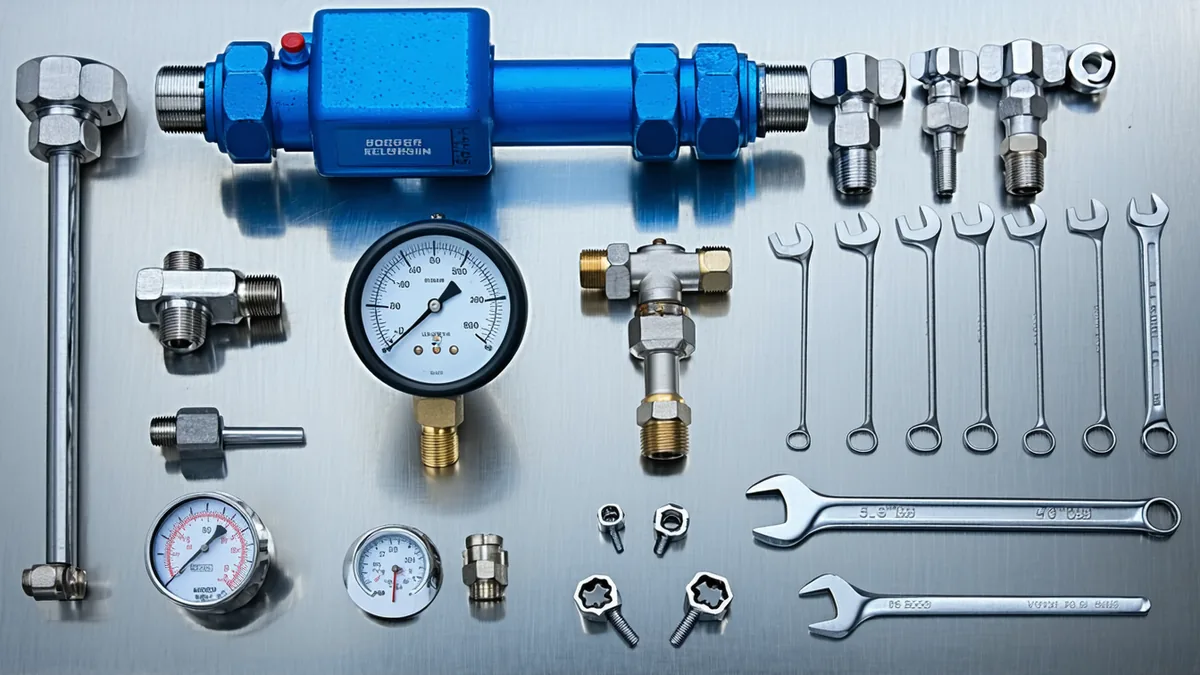
The title of this article names five things: parts pre-staging, route batching, time-of-day optimization, equipment context at dispatch, and failure-severity triage. These aren't theoretical improvements — they're operational levers that directly reduce the cost and time per service call in commercial refrigeration. Each one works on its own; together, they compound into a materially different field service operation.
The underlying premise is that most refrigeration service operations are running below their potential efficiency because dispatch is structured around reacting to calls rather than optimizing across a visible queue. When the queue is visible three to four weeks out — because most upcoming visits are predictive, not reactive — these five levers become applicable. When dispatch is fully reactive, they mostly don't apply.
1. Parts Pre-Staging Before the Technician Leaves
Parts pre-staging is the single highest-ROI dispatch optimization for commercial refrigeration. The most common cause of multi-trip service calls — arriving on-site, diagnosing the failure, then returning after obtaining the required part — is a work order that didn't include a specific parts recommendation at dispatch.
To pre-stage correctly, the work order needs to include a likely failure mode, not just "unit malfunction." A work order that says "vibration anomaly consistent with early bearing wear, scroll compressor model X, recommended parts: bearing kit model Y, secondary check: contactor" gives the dispatcher and technician specific information to pre-stage. They either pull the part from stock or order it before the technician departs.
Parts pre-staging requires two inputs: failure mode classification in the alert (which comes from sensor pattern analysis) and an inventory system that can quickly confirm whether the specified part is in stock. Without failure mode classification, every work order is "bring a broad toolkit and see what you find." That approach produces a first-trip completion rate in the 60–70% range. With specific parts recommendations and a stocking strategy for high-frequency parts (bearing kits for common compressor models, capacitors, contactors, common TXV/EEV metering devices), first-trip completion should reach 90%+.
2. Route Batching by Geography and Appointment Type
Refrigeration technician routes are most efficient when stops are batched geographically and appointment types are mixed sensibly — planned preventive visits interspersed with condition-triggered repairs, not back-to-back emergency calls that span the metro area.
Route batching requires advance visibility. A dispatcher who can see 15 upcoming planned visits over the next two weeks can build routes that cluster stops by zip code, facility type, and estimated repair duration. A dispatcher who only knows today's call queue batches whatever they have, which is usually a poor geographic spread.
The practical impact: technicians in a well-batched route spend 35–45 minutes driving per stop in a metro area. Technicians in a poorly batched reactive route spend 60–90 minutes driving per stop. Over a six-stop day, that's 90–270 minutes of additional drive time — the equivalent of one to two additional service calls that didn't happen because the technician was driving between poorly batched stops.
3. Time-of-Day Optimization for Access and Complexity
Not all service visits are equal in terms of access conditions. A compressor replacement in a busy grocery distribution center loading dock is more efficient at 7am (before peak receiving traffic) than at 11am (peak dock activity). A walk-in cooler visit at a restaurant requires cooler access during kitchen prep — scheduling during off-hours is faster, cleaner, and less disruptive to both the technician and the facility operator.
Time-of-day optimization works as follows: when a work order is created, the dispatcher considers both the technician's route and the facility type. High-traffic facilities get morning-early slots or end-of-day slots. Complex multi-hour repairs get morning starts to avoid running into overtime if the repair takes longer than estimated. PM visits at small facilities with single-person operations get early slots before the facility is busy.
This is a small optimization in isolation — maybe 20–30 minutes per visit — but across a fleet of 60 units and hundreds of annual service calls, the cumulative time savings are meaningful, and the avoided overtime on complex repairs that start late can represent significant cost per incident.
4. Equipment Context at Dispatch: The Work Order Must Contain More Than a Unit ID
A technician who arrives on-site with a work order that says "Unit 12 — vibration alert" needs to locate the unit, read the nameplate, understand the service history, and then diagnose the problem. A technician who arrives with a work order that says "Unit 12 (Copeland ZR32K3 scroll, installed 2020, last PM October 2024, bearing wear pattern in 80–180 Hz band, 6-day trend, discharge temp running 2°C above baseline, prior service note: refrigerant top-off June 2024)" can go directly to the unit, bring the correct tools, and begin the targeted inspection immediately.
Equipment context at dispatch is not just a convenience — it directly reduces diagnostic time and increases the probability that the technician addresses the correct failure mode on the first visit. In cases where the sensor pattern points to a secondary issue (e.g., a refrigerant top-off history suggesting a persistent leak that wasn't fully repaired), the context primes the technician to look for the root cause rather than just replacing the part that failed.
The source of this context is the asset register and service history in the maintenance management system. It has to be populated and maintained — which is why building a complete asset register is foundational, not optional.
5. Failure-Severity Triage: Not All Alerts Have the Same Urgency
A fleet monitoring 60 units will generate alerts at varying urgency levels. Some alerts are early-stage anomalies with 4–6 weeks of lead time before likely failure. Some are mid-stage patterns with 2–3 weeks of lead time. Some are acute patterns requiring service within 72 hours. A small number are immediate — unit is actively failing, product is at risk, dispatch now.
Triage is the process of sorting these alerts into appropriate urgency buckets and dispatch queues. Without triage, dispatchers either treat everything as urgent (burning the technician team on calls that could have been planned) or treat everything as non-urgent (letting urgent calls sit until they become emergencies).
A simple triage framework for refrigeration condition alerts:
- Tier 1 — Schedule within 3–4 weeks: Early-stage anomaly, no immediate risk to product. Route-batch and schedule based on geographic efficiency.
- Tier 2 — Schedule within 1 week: Mid-stage anomaly or elevated risk based on unit age/history. Prioritize in the current week's dispatch queue.
- Tier 3 — Schedule within 48–72 hours: Acute pattern or active efficiency degradation with product risk possible. Contact facility manager, confirm product status, dispatch as near-term priority.
- Tier 4 — Immediate dispatch: Unit is in active failure mode, temperature excursion in progress, or vibration exceeds safety threshold. Standard emergency dispatch protocol.
We're not saying this triage framework is universal — the right thresholds depend on your specific fleet, product types, and facility sensitivity. The point is that triage needs to happen explicitly, with documented criteria, rather than informally. When criteria are explicit, they can be applied consistently and adjusted based on outcome data. When they're implicit, the same alert gets different treatment depending on who's dispatching that day.
The Compound Effect Across a Full Year
Each of these five improvements moves a different efficiency metric. Pre-staging improves first-trip completion rate. Route batching reduces drive time per call. Time-of-day optimization reduces overtime exposure. Equipment context reduces diagnostic time. Severity triage prevents unnecessary emergency escalations.
Individually, each might save $50–$150 per service call in labor and overhead. Across a fleet running 150–200 service visits per year, the aggregate impact is a meaningful reduction in annual maintenance spend — without reducing service quality or cutting corners on inspection thoroughness. The improvement comes from doing the same work more intelligently, not from doing less work.